Group by
Use a SodaCL group by configuration to customize the group of data quality check results by category.
Use a group by configuration to collect and present check results by category.
checks for fact_internet_sales:
- group by: # Not supported in Soda Core
query: |
SELECT sales_territory_key, AVG(discount_amount) as average_discount
FROM fact_internet_sales
GROUP BY sales_territory_key
fields:
- sales_territory_key
checks:
- average_discount:
fail: when > 40
name: Average discount percentage is less than 40% (grouped by sales territory)✖️ Requires Soda Core Scientific (included in a Soda Agent) ✖️ Supported in Soda Core ✔️ Supported in Soda Library + Soda Cloud ✔️ Supported in Soda Cloud Agreements + Soda Agent ✖️ Available as a no-code check
Define a group by configuration
For an individual dataset, add a group by configuration to specify the categories into which Soda must group the check results.
The example below uses a SQL query to define a custom metric for the fact_internet_sales dataset. It calculates the average order discount based on the contents of the discount_amount column, then groups the results according to the value in the sales_territory_key. This check supports up to a maximum of 1000 groups.
The check itself uses the custom metric average_discount and an alert configuration to determine if the measurement for each group passes, warns, or fails. In this case, any calculated measurement for average that exceeds 40 results in a fail.
group by
required
configuration section label
group_limit
optional
the maximum number of groups, or column values, into which Soda must categorize the results. This value must correspond with the number of unique values in the column you identify in the fields section; see example below. This check supports up to a maximum of 1000 groups.
group_name
optional
specify a name for the group; Soda does not evaluate this parameter
query
required
custom query subsection label. The nested SQL query defines the custom metric average_discount
fields
required
column subsection label
sales_territory_key
required
column identifier; the values in this column identify how Soda groups the results.
checks
required
check subsection label
average_discount
required
custom metric identifier
fail: when > 40
required
fail condition and threshold
warn: when between 50 and 60
only one alert condition is required
warn condition and threshold
name
optional
custom name for the check; it not defined, Soda derives the name of the check in Soda Cloud from the check syntax
You can also use multi-column groups in a group by check, as in the example below that groups results both by gender and english_education.
Group by check results
When you run a scan that includes checks nested in a group by configuration, the output in Soda Library CLI groups the results according to the unique values in the column you identified in the fields subsection. The number of unique values in the column must match the value you provided for group_limit.
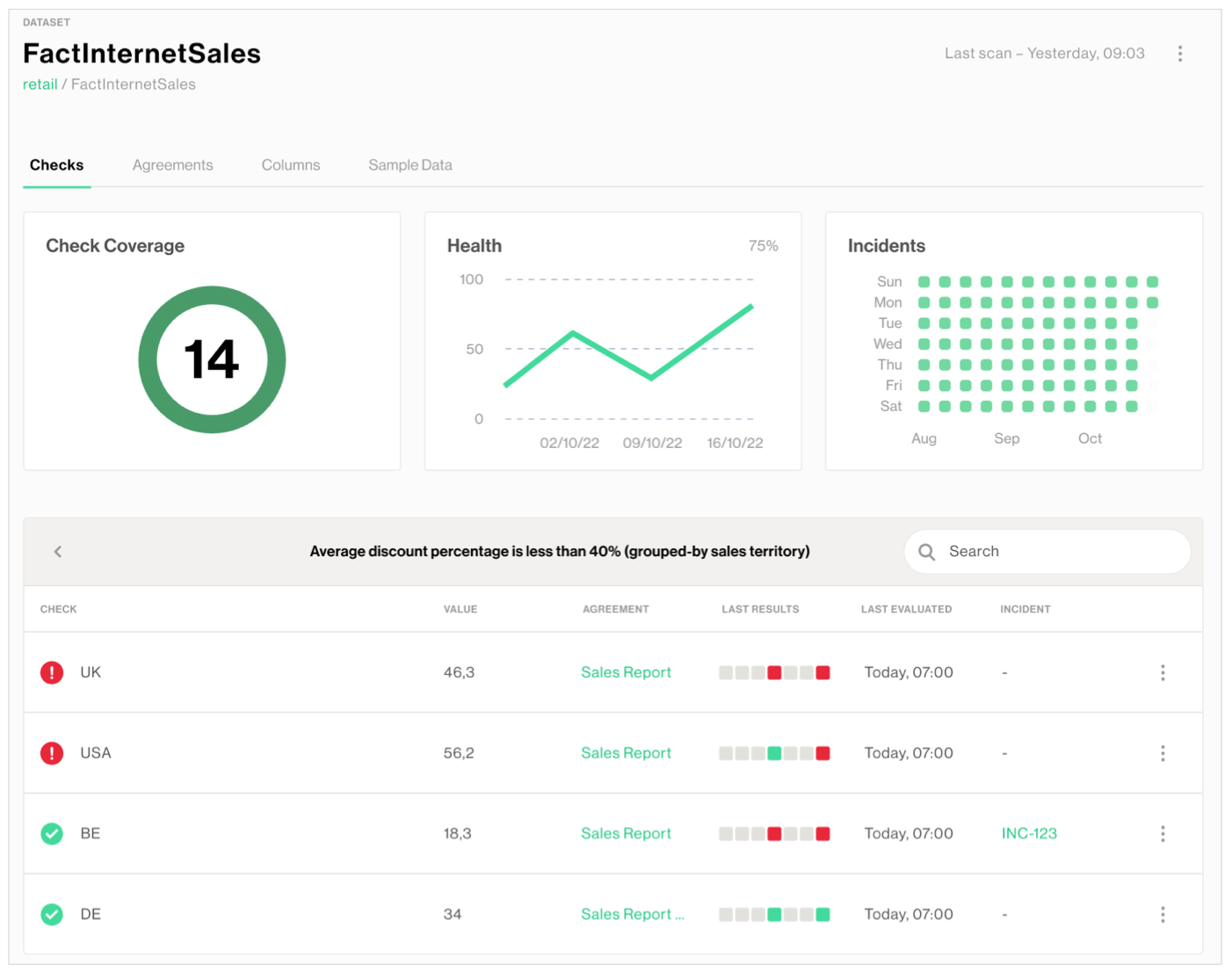
In the example results below, the calculated average of average_discount for each sales territory is less than 40%, so the check for each group passed. The value in the square brackets next to the custom check name identifies the group which, in this case, is a number that corresponds to a territory.
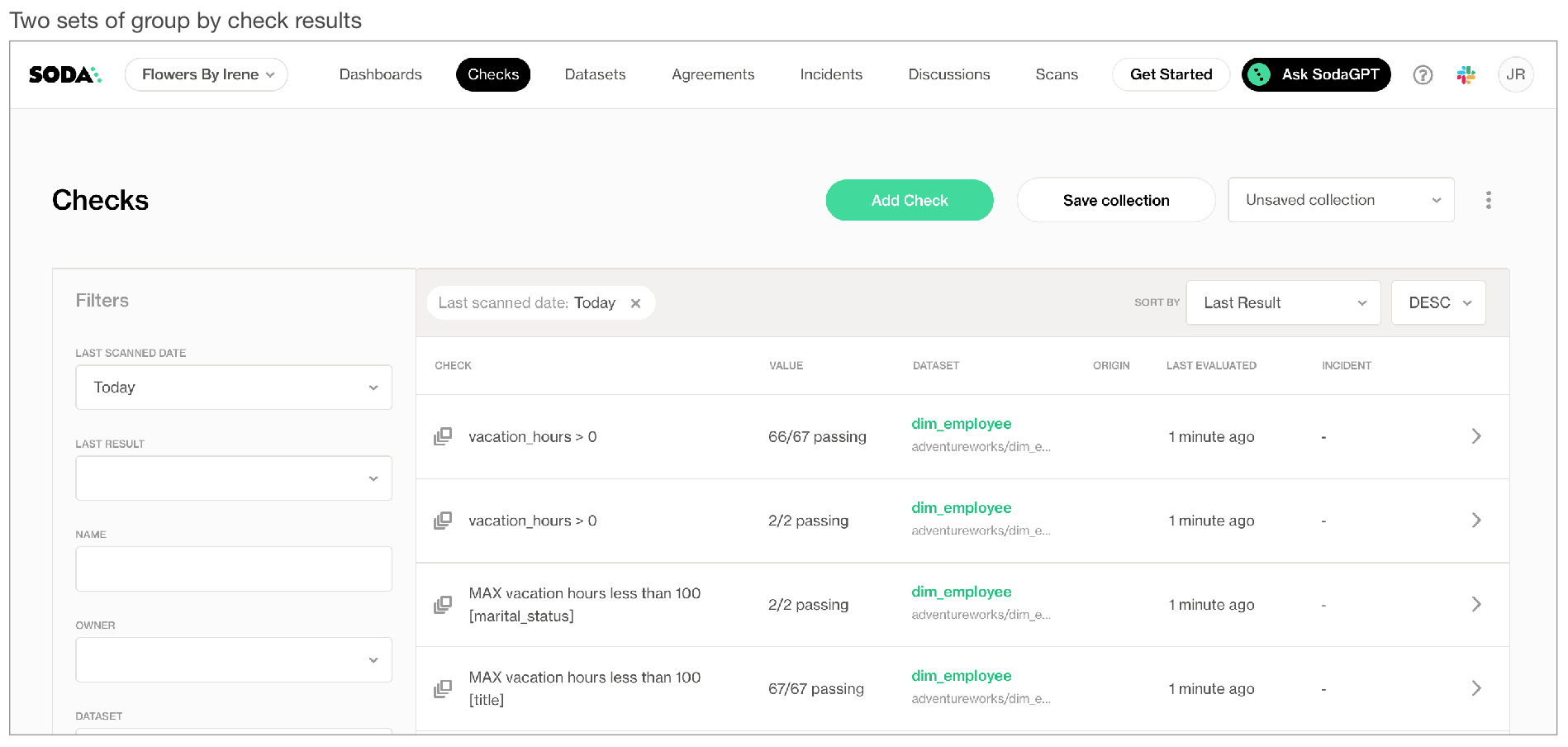
In Soda Cloud, the check results appear by territory.

Be aware that a check that contains one or more alert configurations only ever yields a single check result; one check yields one check result. If your check triggers both a warn and a fail, the check result only displays the more severe, failed check result. (Schema checks behave slightly differently; see Schema checks.)
Using the following example, Soda Library, during a scan, discovers that the data in the dataset triggers both alerts, but the check result is still Only 1 warning. Nonetheless, the results in the CLI still display both alerts as having both triggered a [WARNED] state.
The check in the example below data triggers both warn alerts and the fail alert, but only returns a single check result, the more severe Oops! 1 failures.
Optional check configurations
✓
Define alert configurations to specify warn and fail alert conditions; see example
Apply an in-check filter to return results for a specific portion of the data in your dataset.
-
✓
Use quotes when identifying dataset or column names; see example. Note that the type of quotes you use must match that which your data source uses. For example, BigQuery uses a backtick (`) as a quotation mark.
✓
Use wildcard characters in the value in the check.
Use wildcard values as you would with SQL.
Use for each to apply group by checks to multiple datasets in one scan.
-
Apply a dataset filter to partition data during a scan.
-
Example with check name
When the check results appear in Soda Cloud, the checks use the name you define for the check or, if you do not specify a name parameter, the syntax of the check itself.
Example with identity
See also: Change configurations and preserve check history.
Example with alert configuration
Be aware that Soda only ever returns a single check result per check. See Expect one check result for details.
Example with quotes
Note that the type of quotes you use must match that which your data source uses. For example, BigQuery uses a backtick (`) as a quotation mark.
Add multiple group configurations
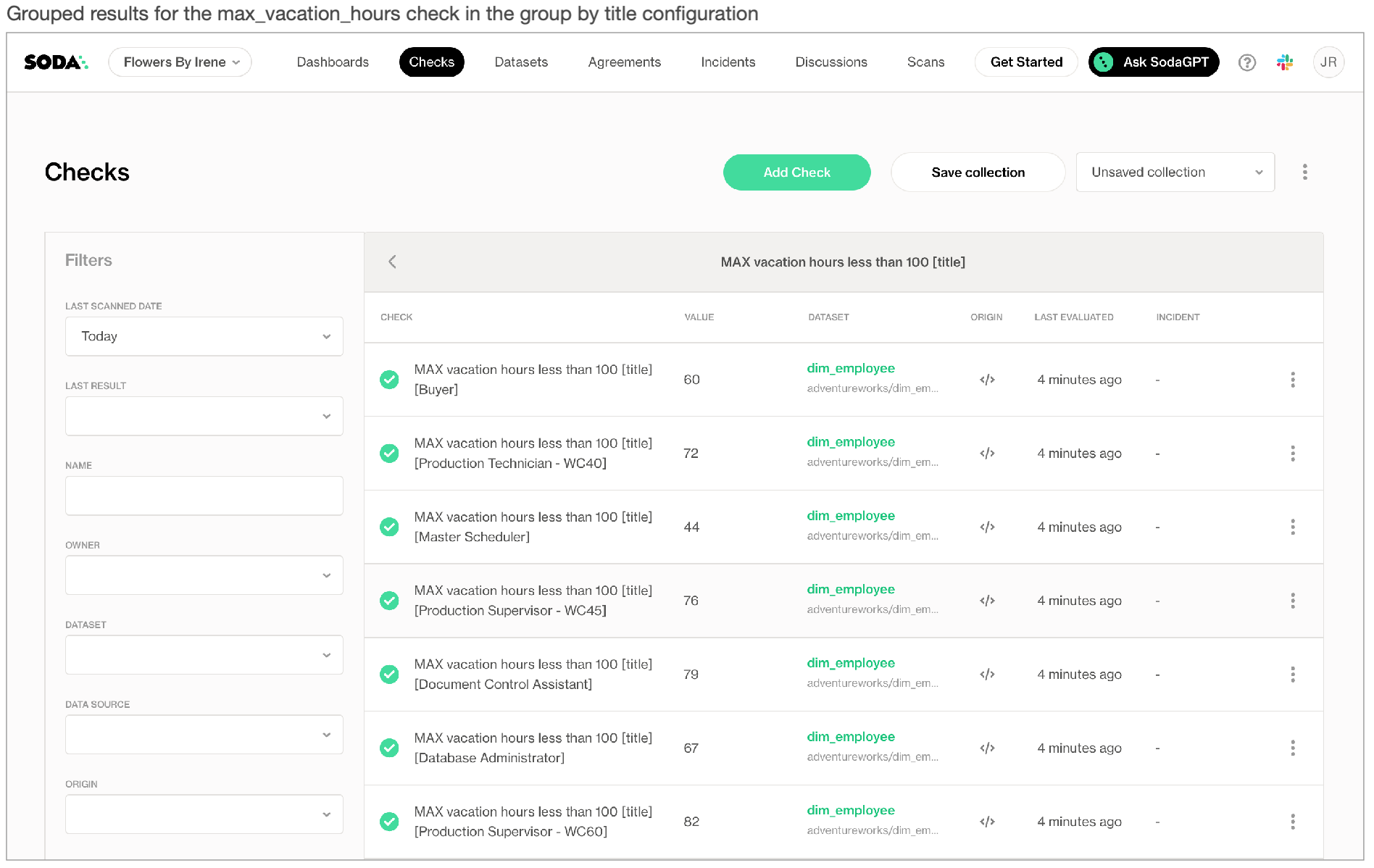
You can add multiple group by configurations to the same dataset in the same checks YAML file and produce separately grouped check results. To do so, you must include an identifier in the group by configuration key of the extra group configurations you add, as in the example below.
The first
group byin the example requires no identifier, though for readability and completeness, you have the option of adding one.The second
group byincludestitleas an identifier to differentiate it from the first.
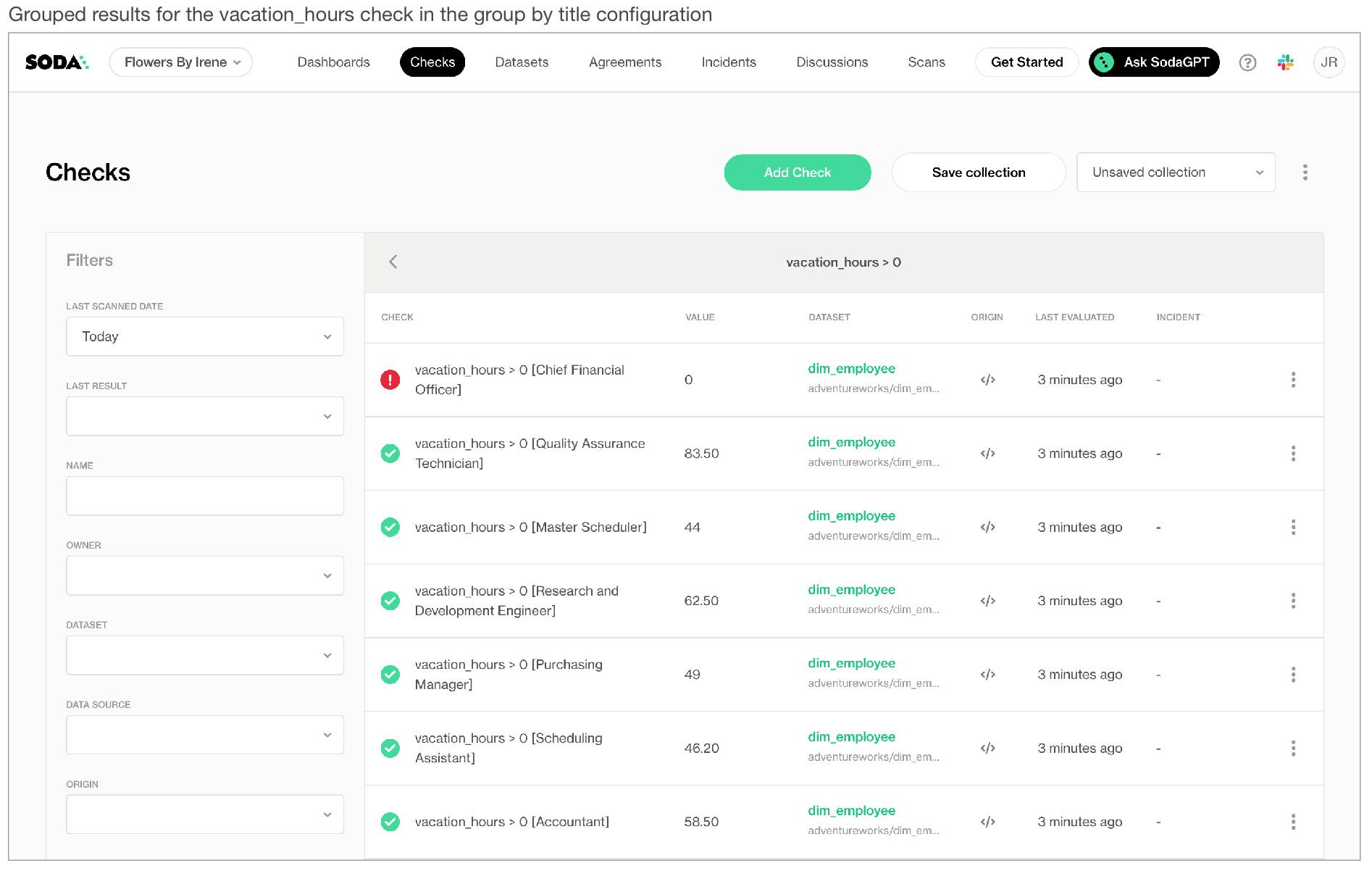
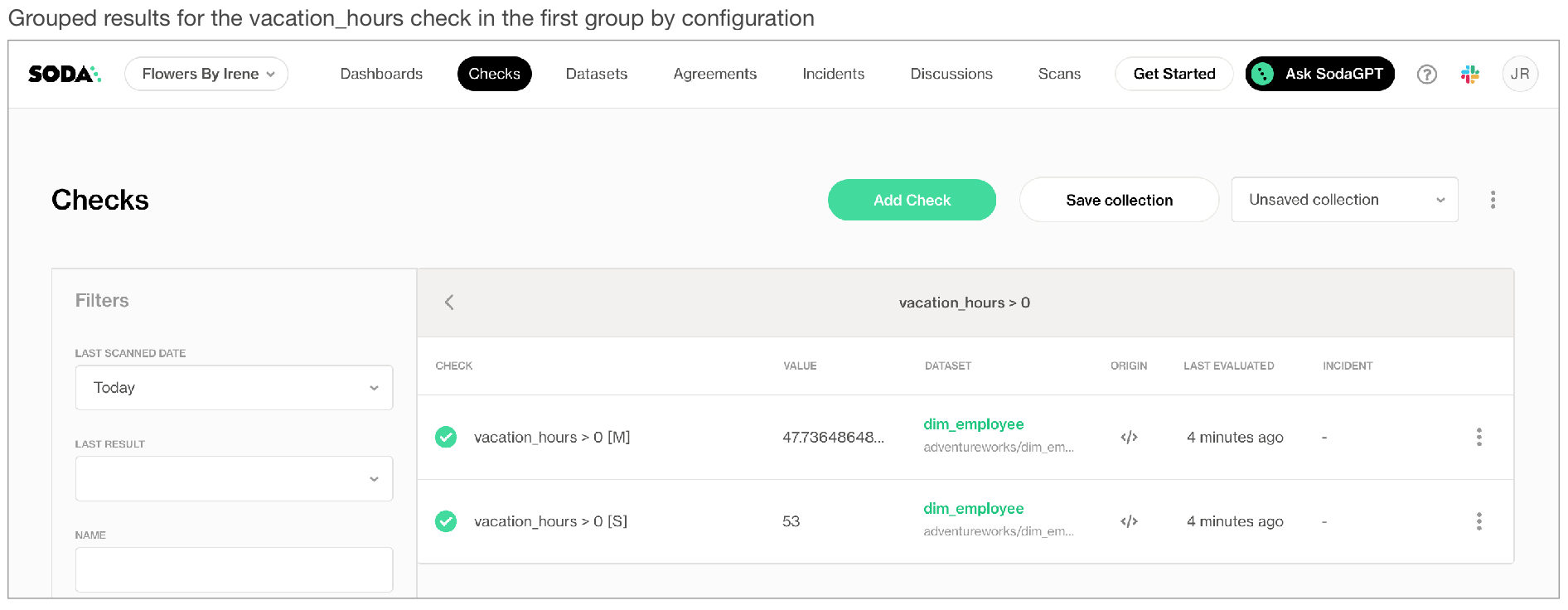
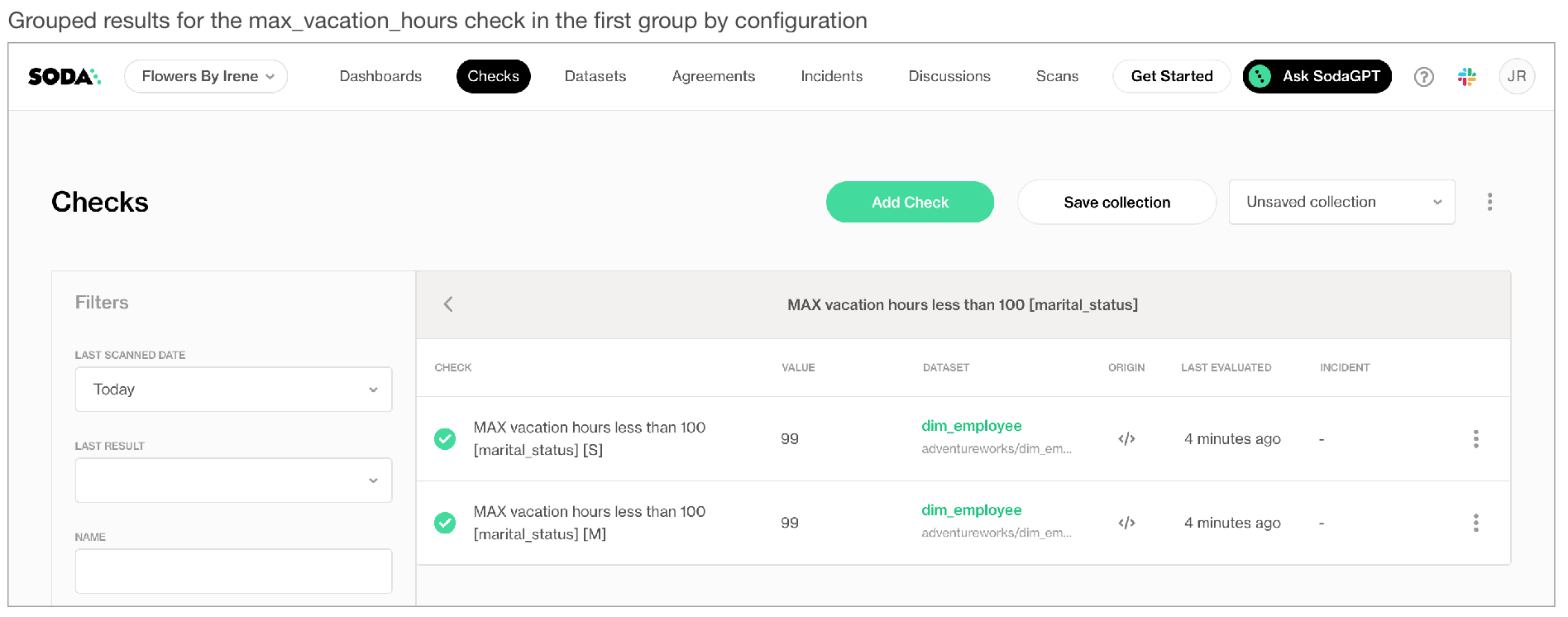
When the check results appear in Soda Cloud, the checks use the name you define for each check or, if you do not specify a name parameter, the syntax of the checks themselves. The group by identifiers appear in the CLI output, but do not appear the the check results in Soda Cloud.


Change configurations and preserve check history
When you make changes to your group by configuration, some changes result in a resetting of the check history in Soda Cloud.
The following changes result in a reset of a group by check's history; all historical measurements disappear.
change the list of
fields, either adding, removing, or changing an existing fieldchange the
group byidentifier when more than onegroup byconfigurations exist; see Add multiple group configurationschange the syntax of a group by check such as, a change to the threshold value; see Configure variables in SodaCL to mitigate disruption using dynamic threshold values
The following changes result in no changes to the check's history; Soda preserves all historical measurements to a maximum of 90 days.
change the SQL query that forms part of the
group byconfigurationadd a check to the
group byconfiguration
Further, you can add an identity parameter to a group by check to be able to make changes to the check and still preserve its historical measurements, as in the example below. See also: Add a check identity.
Track anomalies and relative changes by group
You can use a group by configuration to detect anomalies by category, and monitor relative changes over time in each category.
✔️ Requires Soda Core Scientific for anomaly check (included in a Soda Agent) ✖️ Supported in Soda Core ✔️ Supported in Soda Library 1.1.27 or greater + Soda Cloud ✔️ Supported in Soda Cloud Agreements + Soda Agent 0.8.57 or greater ✖️ Available as a no-code check
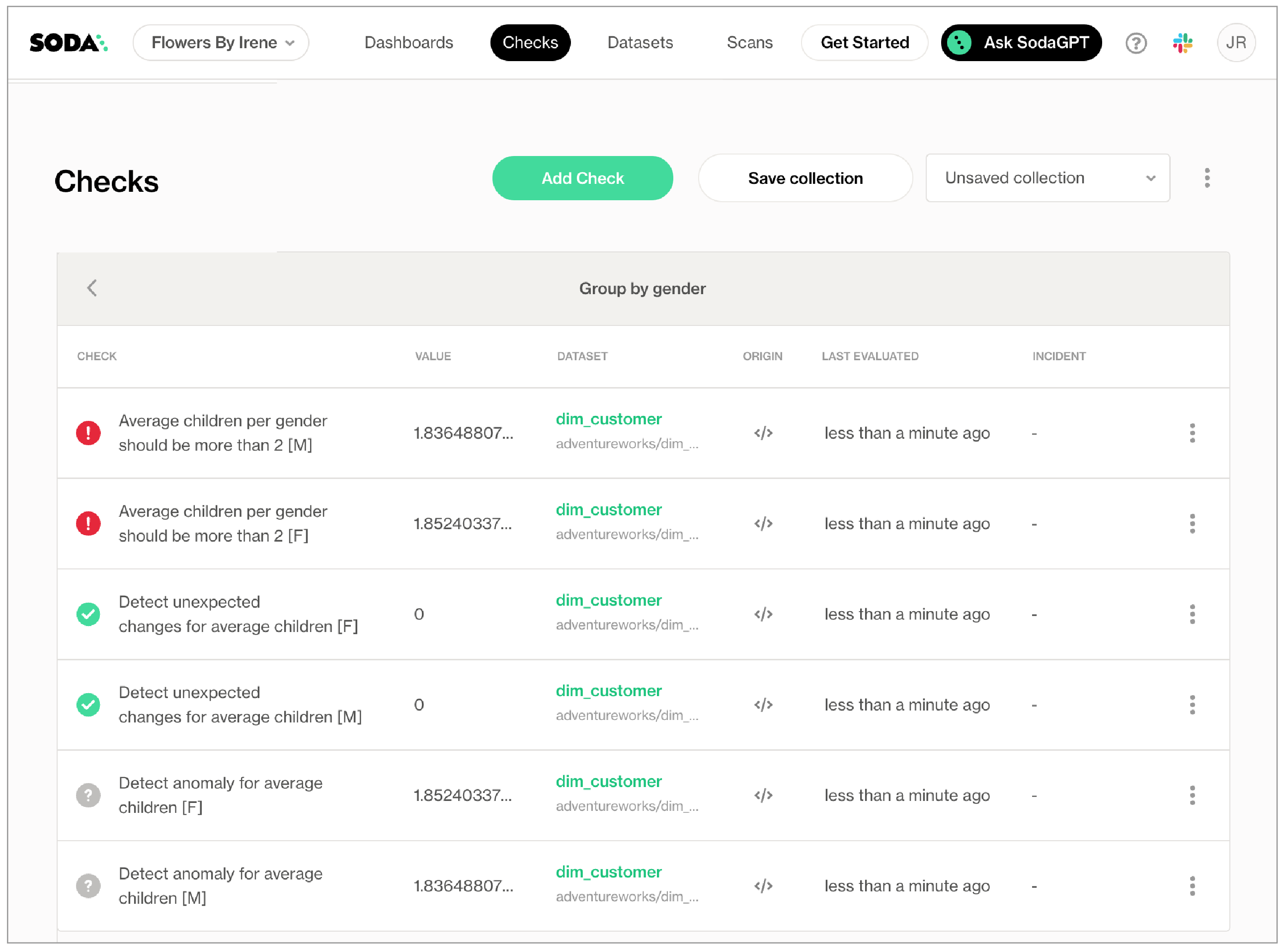
The following example includes three checks grouped by gender.
The first check uses the custom metric
average_childrento collect measurements and gauge them against an absolute threshold of2. Soda Cloud displays the check results grouped by gender.The second check uses the same custom metric to detect anomalous measurements relative to previous measurements. Soda must collect a minimum of four, regular-cadence, measurements to have enough data from which to gauge an anomolous measurement. Until it has enough measurements, Soda returns a check result of
[NOT EVALUATED]. Soda Cloud displays any detected anomalies grouped by gender.The third check uses the same custom metric to detect changes over time in the calculated average measurement, and gauge the measurement against a threshold of
between -5 and 5relative to the previously-recorded measurement. See Change-over-time thresholds for supported syntax variations for change-over-time checks. Soda Cloud displays any detected changes grouped by gender.

Troubleshoot
If you use an optional group_limit parameter, you must always match the number of unique values in the group by column to the value you provide for the parameter.
In the following example, the number of unique values in the sales_territory_key column is greater than the group_limit: 2 so Soda does not evaluate the check.
Resolve the issue by increasing the group limit value, or by removing the parameter entirely.
Go further
Use a group evolution check to surface changes in groups in a dataset.
Learn more about alert configurations.
Learn more about SodaCL metrics and checks in general.
Need help? Join the Soda community on Slack.
Last updated
Was this helpful?